Home / Blog / Artificial intelligence and copyright – what do the experts say?
Artificial intelligence and copyright – what do the experts say?
Copyright
February 13, 2026
Share:
We are entering an era in which artificial intelligence (AI) is no longer just a technological novelty, but a powerful tool that is rewriting the rules of creativity. The issue of copyright and the application of AI in the digital age is becoming increasingly complex as the line between human inspiration and machine-generated content is blurring. In this dynamic environment, laws are constantly changing to meet new challenges, making the need for expert legal advice more critical than ever.
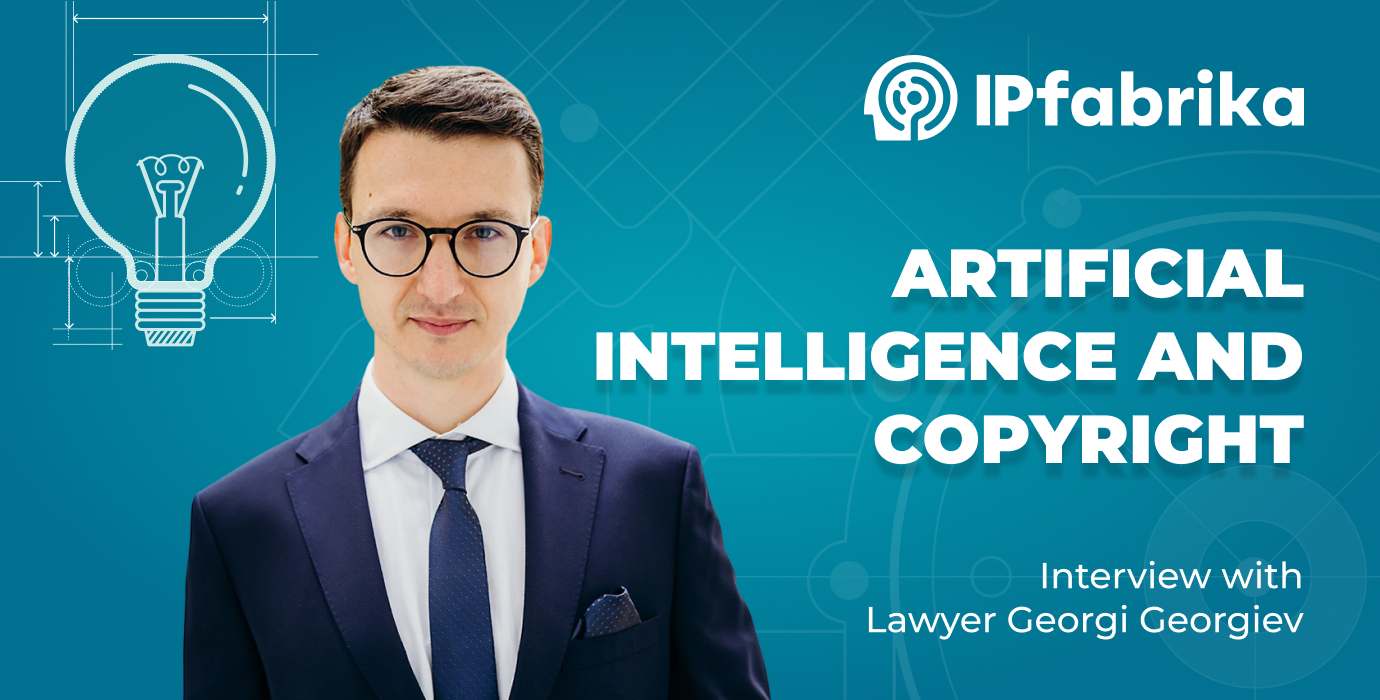
To clear up the legal fog, we speak with attorney Georgi Georgiev – co-founder of IPfabrika.
Attorney Georgiev has extensive experience in trademark registration and protection before the Bulgarian, European (EUIPO) and World Intellectual Property Offices (WIPO). In addition to being an experienced lawyer, he often acts as an angel investor, actively supporting innovative companies with the potential for sustainable growth.
How often do you receive inquiries related to the Internet and copyright? From what individuals or legal entities do such questions come?
Over the last two or three years, we have observed a real boom in inquiries in this area, which is a direct consequence of the mass digitalization of business, the explosive growth of social networks as a main sales channel, the development of artificial intelligence and its entry into creative processes.
Questions come from a wide range of entities, including freelance artists, software developers, marketing agencies, e-retailers, and large technology companies.
Examples of such cases are diverse: inquiries about the lawful use of images and music in advertising campaigns, clarification of ownership of software code, complex legal analyses regarding database protection and the compliance of AI models with current intellectual property legislation.
We are also often sought after to draft rights assignment agreements, where the scope of use in a digital environment must be clearly defined.
What, in essence, is artificial intelligence training and what legal cases does it create?
Training artificial intelligence is the process of feeding algorithms with vast amounts of data, including text, images, and code. Through this, the machine learns to recognize patterns and generate new content. Technically, this requires reproducing objects that are often protected by copyright.
This is where the main legal clash arises: are these works being used lawfully, or does the teaching constitute a violation of the rights of their creators without explicit consent.
The main cases are related to the so-called "text and data mining". European legislation allows such extraction, unless the rights holders have explicitly stated that they prohibit it. The complicated point comes when determining the authorship of the final product.
Since the law only recognizes a natural person as an author, AI results remain in a “gray area.” This creates uncertainty about the protection of investments in content created with the help of new technologies.
What do you mean by "gray area"?
The “gray area” in law occurs where technology outpaces the legal framework. In the context of artificial intelligence, the main problem is the lack of a legal definition of how much human participation must be involved in order for a work to be recognized as a subject of copyright. Since the law requires “creative thought” by a natural person, works generated entirely by an algorithm theoretically fall into a legal vacuum.
Let’s illustrate with a practical example. Imagine a business that invests significant resources in an advertising campaign whose visual style is entirely generated by AI. Since there is minimal creative control in this case, the company may not be able to obtain legal protection over these images.
If a competitor simply copies and uses the same vision for their campaign, you will be in an extremely difficult position in court because you will not have the exclusive right to prohibit the use of that product. It is this uncertainty about investment protection and property rights that we call the “gray area”.
AI and copyright case filing data
Year
Approximate number of cases
Main focus of claims
2023
~35
Copyright and illegal data collection (Scraping)
2024
~90
Privacy and personal data breaches from social networks
2025
~200
Cybersecurity, AI fraud and regulatory violations (EU AI Act)
Does this mean that human creators are completely protected in this regard?
Absolutely not. Although the law only recognizes their creative contribution, authors face unprecedented threats.
First, their works are used to train AI models without their consent or compensation. Second, the market is flooded with low-budget AI content, undermining the economic value of their work.
Protection is difficult because proving that a particular algorithm copied a specific style or element is technically and legally complex. So, despite being the only legitimate authors, creators are more vulnerable than ever in the digital environment today.
And what can we say about the personal content we post on social media or other public platforms?
This is one of the biggest myths on the internet – that once published, content becomes “public.” Legally, you retain the copyright to your photos, texts, and videos. The problem, however, lies in the terms and conditions of each specific platform. By accepting them, you grant them a non-exclusive, royalty-free, and transferable license to use, modify, and distribute your content worldwide.
In practice, you don’t lose ownership, but you lose control over how the platform disposes of it. In the context of artificial intelligence, the situation becomes even more complicated. Most social networks already use their users’ public content to train their own AI models.
This means that your personal photos or articles can serve as the “raw material” through which an algorithm learns to imitate your style or even your face. Protection in these cases is limited to privacy settings and opt-out options that platforms are required to provide, but few users take advantage of them effectively.
How can the average internet user know if their content – personal or professional – has been used by an AI system?
This is a technical challenge, but not impossible. You can use specialized tools like Have I Been Trained that check if your images are present in the large training datasets.
For text content, search for parts of your authored materials through AI chatbots – if they reproduce specific passages or style with high accuracy, they have probably mastered them in advance.
However, the most effective prevention is placing NoAI tags in the metadata and using software tools (such as Glaze or Nightshade) that “poison” the data and make it unusable for AI.
And how can we seek our rights if we find out that our content has been used illegally?
Legal protection begins with proper evidence gathering – the violation must be documented (e.g. through forensic reports or digital fingerprints) before it can be removed. The first step is usually to send a formal warning notice to the infringer or platform.
If this does not lead to a result, administrative procedures are initiated before the supervisory authorities or a lawsuit is filed to terminate the violation and pay compensation for damages suffered and lost profits.
In these complex cases where law meets high technology, experience is crucial. The team of lawyers and legal professionals at IPfabrika has the expert knowledge and proven professionalism in protecting intellectual property in a digital environment.
We provide full legal support to companies and individuals, developing customized protection strategies – from preventive measures to litigation representation. Our mission is to ensure that your creative work remains protected, regardless of the speed of technological development.
One of the most interesting cases in IP Fabrika's practice is related to the attempt to register the trademark "Cards against Bulgarianness". The case took us nearly three years and unfortunately resulted in...
Did you know that a trademark can be protected on an “intention to use” basis? This means that you can protect your trademark before you start using it in commerce.